
The Steep Down
Swing Can Be A Killer
All pictures were taken at Ocean Trails Golf Club, which is now Trump National Golf Club Los Angeles, in Rancho Palos Verdes, California.
A backswing plane that is upright, or steep, can work very well as long as plane is flattened during the transition to the forward swing. This is a crucial adjustment good players make and it is what keeps good players from making the mistakes I mention below.

In the first picture the shaft is pointing almost straight down.
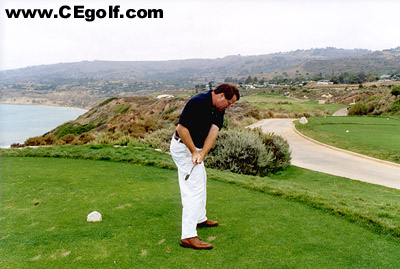
The second picture shows what would happen if I were to come down in such a steep swing plane—my right arm gets stuck beside my body with nowhere to go (the ultimate block) and the club is too far inside to hit the ball. I've exaggerated the problem so it's easier to see.
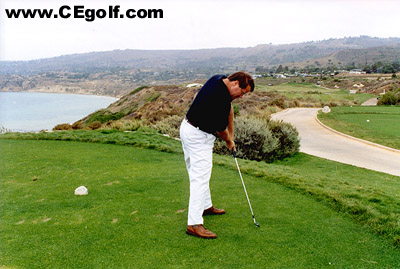
The third picture shows another problem. Notice that the clubface is wide open, pointing to the right by about 45 degrees. This is what happens as the arms pull across the body (block), which is the tendency with a steep downswing. To compensate, the golfer has to find some way to manipulate the club so that the face gets as close to square as possible at impact.
The most common manipulation for the amateur golfer with a steep forward swing is the "over-the-top" and "casting" combination, which I discuss on another page. This is where the golfer pushes the clubhead outside with arms and wrists at the beginning of the forward swing. The motion helps get the club out to the ball and also begins to close the clubface, but is very inefficient.
I want to reiterate: good players who have steep backswing planes flatten their planes (reroute) as they transition into the forward swing. Jim Furyk and Ryan Palmer are extreme examples of this type of steep to flatter rerouting.
If you're having trouble with the navigaton bar (left), try the CEGolf.com Contents page.
Casey Eberting Golf Instruction
©Copyright 1997-2024, All Rights Reserved